Marketing is the foundation of every successful business strategy. It helps organizations understand what customers need, how to deliver value, and how to build long-term relationships. Over time, experts have developed several marketing models to simplify decision-making and improve results.
The most recognized among them are the 4Ps, 7Ps, 8Ps, 4Cs, and 7Cs of Marketing. Each of these models provides a framework for designing, analyzing, and refining marketing strategies.
Before diving into each model, let’s first understand what the “Ps” represent in marketing.
What Do the “Ps” in Marketing Stand For?
The “Ps” in marketing stand for the different elements of the marketing mix, the tools and factors businesses use to influence customers and achieve their goals. Each “P” represents a component that must be managed and balanced carefully for marketing success.
Here’s a brief overview of all the Ps commonly used in marketing frameworks:
- Product – The item or service created to meet customer needs.
- Price – The amount a customer pays in exchange for the product.
- Place – The location or method through which the product reaches the customer.
- Promotion – The communication activities used to make customers aware of the product.
- People – Individuals involved in delivering the service and representing the business.
- Process – The procedures and flow of activities that create customer satisfaction.
- Physical Evidence – The tangible or visible proof of service quality or brand credibility.
- Performance – The results and effectiveness of all marketing efforts.
Each “P” plays a key role in helping a company position its products effectively, meet customer expectations, and sustain business growth.
The 4Ps of Marketing
The 4Ps of Marketing (Product, Price, Place, and Promotion) form the original marketing mix introduced by E. Jerome McCarthy. This model focuses on how businesses can bring their products to market effectively.
- Product
This refers to what the company offers, whether a physical item or a service. It should meet customer needs and provide clear value. Key factors include quality, design, features, and branding. - Price
Price is what customers pay for the product. It influences perceptions of value and competitiveness. Pricing strategies may include discounts, premium pricing, or penetration pricing. - Place
Place represents how and where a product is distributed. The goal is to make it easy for customers to access the product through stores, websites, or distribution networks. - Promotion
Promotion covers all methods of communication used to inform and persuade customers, such as advertising, public relations, or direct marketing.
The 7Ps of Marketing
The 7Ps model expands on the 4Ps by adding People, Process, and Physical Evidence, key elements for service-based industries.
- People
People are at the heart of any service. Employees, customer service staff, and management influence the customer’s experience and satisfaction. - Process
Process refers to how services are delivered and how smoothly transactions occur. An efficient process improves consistency and customer trust. - Physical Evidence
Physical evidence provides visible proof of quality and reliability. Examples include brochures, store design, packaging, or online reviews.
This model helps organizations provide better service and create stronger relationships with customers.
The 8Ps of Marketing
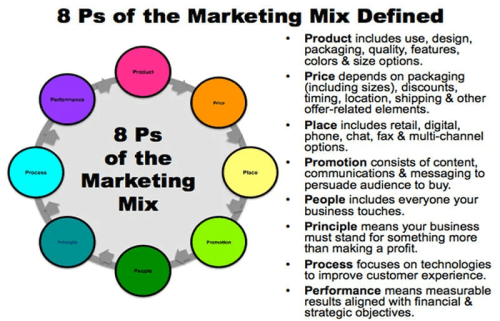
The 8Ps of Marketing further develop the 7Ps by introducing the concept of Performance, a measure of how well all marketing efforts work together.
- Performance
Performance focuses on evaluating results, such as customer satisfaction, sales growth, market share, and brand strength. It ensures that marketing strategies lead to measurable outcomes and continuous improvement.
This addition helps businesses assess effectiveness and adapt strategies for better long-term success.
The 4Cs of Marketing
While the 4Ps focus on the business perspective, the 4Cs of Marketing (Customer, Cost, Convenience, and Communication) shift the focus toward the customer’s point of view.
- Customer
Businesses must identify and understand customer needs before designing a product. Success depends on how well a company can satisfy those needs. - Cost
Cost includes not just the price but the total expense to the customer, including time, effort, and maintenance. - Convenience
Convenience emphasizes how easy it is for customers to find, purchase, and use a product or service. - Communication
Instead of one-way promotion, this element focuses on building an open and ongoing dialogue with customers.
The 4Cs model encourages companies to create more customer-centered marketing strategies.
The 7Cs of Marketing
The 7Cs of Marketing provide a modern and digital-focused approach to customer engagement. It emphasizes building strong connections and consistency across all communication channels.
- Customer – The central focus of all marketing efforts.
- Content – Valuable and relevant information that attracts and retains customers.
- Context – Delivering the right message at the right time and place.
- Community – Building a loyal audience and fostering relationships.
- Customization – Personalizing experiences to meet individual needs.
- Convenience – Making access to products and services simple and seamless.
- Consistency – Maintaining uniform messaging and quality across all platforms.
This framework is particularly effective for maintaining strong brand identity and long-term relationships.
Comparison Summary
| Model | Main Focus | Key Elements |
|---|---|---|
| 4Ps | Product-oriented | Product, Price, Place, Promotion |
| 7Ps | Service-oriented | 4Ps + People, Process, Physical Evidence |
| 8Ps | Performance-oriented | 7Ps + Performance |
| 4Cs | Customer-oriented | Customer, Cost, Convenience, Communication |
| 7Cs | Relationship-oriented | Customer, Content, Context, Community, Customization, Convenience, Consistency |
Final Thoughts
The 4Ps, 7Ps, 8Ps, 4Cs, and 7Cs of Marketing together represent a complete guide to understanding both business and customer perspectives.
- The 4Ps help in building strong marketing foundations.
- The 7Ps improve service quality and customer experience.
- The 8Ps emphasize performance and results.
- The 4Cs highlight customer satisfaction.
- The 7Cs focus on building consistent, long-term relationships.
By combining these models, businesses can create marketing strategies that are balanced, customer-focused, and result-driven.
The 4Ps, 7Ps, 8Ps, 4Cs, and 7Cs of Marketing are essential frameworks that guide businesses in planning effective marketing strategies. The 4Ps (Product, Price, Place, Promotion) focus on business offerings, while the 7Ps add People, Process, and Physical Evidence for service excellence. The 8Ps include Performance to measure results. The 4Cs (Customer, Cost, Convenience, Communication) shift focus to customer needs, and the 7Cs emphasize digital consistency with elements like Content, Context, and Community. Together, these models help create customer-centered, high-performing marketing strategies that drive growth and brand loyalty.



Leave a comment