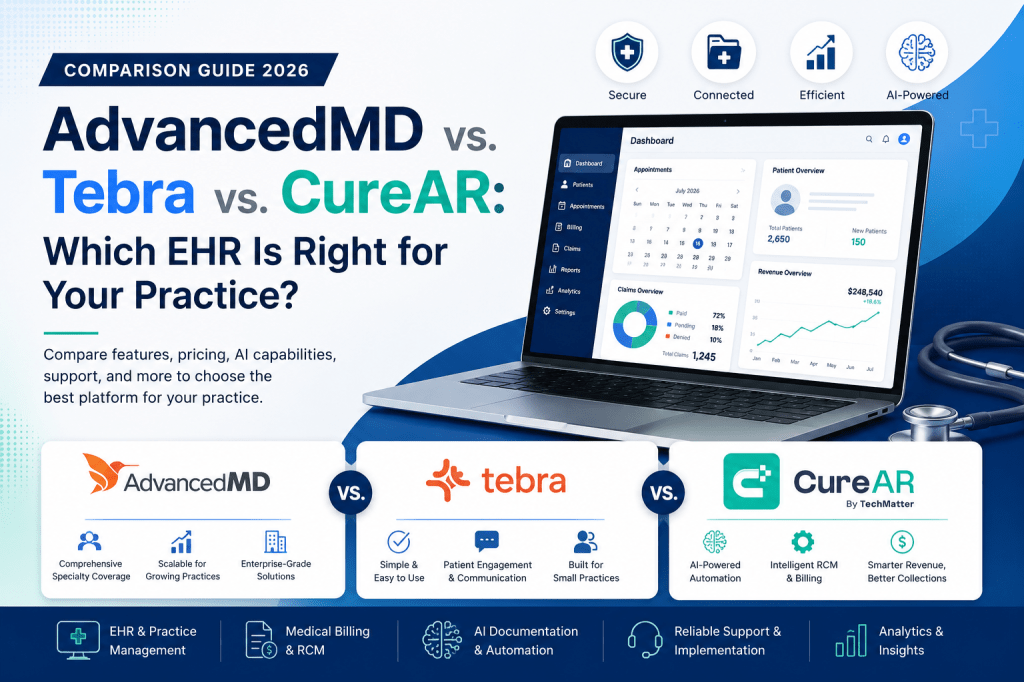
Choosing the right electronic health record (EHR) and practice management platform is one of the most important decisions for any healthcare organization. AdvancedMD, Tebra, and CureAR all help practices manage clinical documentation, scheduling, billing, and revenue cycle operations, but each platform is built with a different type of practice in mind.
AdvancedMD is a mature, enterprise-grade platform designed for growing independent practices, multispecialty groups, and organizations that require advanced billing capabilities and workflow customization.
Tebra (formerly Kareo) focuses primarily on small and independent practices, offering an easy-to-use interface, integrated patient engagement tools, and AI-powered documentation through partner integrations.
CureAR is a modern AI-powered healthcare platform that combines electronic health records, medical billing, revenue cycle management, automation, and intelligent analytics into a single ecosystem. It is designed for practices that want to reduce administrative workload while improving financial performance through automation.
This comparison examines pricing, features, AI capabilities, billing functionality, support, and scalability to help you determine which solution best fits your practice.
Quick Verdict
Choose AdvancedMD if:
- You manage a multi-provider or multi-location practice.
- Your organization requires extensive specialty support and customizable workflows.
- You need flexible pricing options, including per-provider or per-encounter billing.
- Your practice depends on robust practice management and revenue cycle tools.
- You prefer U.S.-based customer support with extensive implementation services.
Choose Tebra if:
- You operate a solo or small independent practice.
- Simplicity and ease of implementation are your highest priorities.
- Your specialty is primary care, pediatrics, behavioral health, or another common outpatient practice.
- You want integrated patient communication and marketing tools.
- You need both Android and iOS mobile support.
Choose CureAR if:
- You want an AI-first healthcare platform rather than a traditional EHR.
- Automating medical billing, coding, claims, and revenue cycle management is a priority.
- You want AI-assisted documentation and workflow automation built directly into your system.
- Your practice is focused on improving collections, reducing denials, and increasing operational efficiency.
- You prefer a unified platform that combines clinical workflows with intelligent revenue management.
Feature Comparison
| Feature | AdvancedMD | Tebra | CureAR |
|---|---|---|---|
| EHR | ✔ | ✔ | ✔ |
| Practice Management | ✔ | ✔ | ✔ |
| Medical Billing | Native | Native | AI-Powered Native |
| Revenue Cycle Management | Advanced | Standard | Intelligent Automation |
| AI Documentation | Available | Third-party Integration | Native AI |
| AI Coding Assistance | Limited | Limited | Native AI |
| Claims Automation | Standard | Standard | Advanced AI |
| Denial Management | Available | Basic | AI-Driven |
| Patient Portal | ✔ | ✔ | ✔ |
| Telehealth | Native | Native | Native |
| Mobile Access | iOS Focus | iOS & Android | Web & Mobile |
| Analytics & Reporting | Advanced | Standard | AI Analytics |
| Workflow Automation | Moderate | Moderate | Extensive |
| Scalability | Enterprise | Small Practices | Small to Enterprise |
Pricing
Pricing structures vary significantly across these platforms.
AdvancedMD offers flexible pricing models, allowing practices to choose between per-provider and per-encounter pricing. This flexibility can benefit organizations with fluctuating patient volumes or unique operational requirements.
Tebra primarily follows a subscription-based per-provider pricing model, making costs predictable for smaller practices. Additional services such as managed billing and implementation may increase the overall investment.
CureAR provides customized pricing based on practice size, workflow requirements, and selected modules. Because it combines EHR, billing, AI automation, and revenue cycle management into one platform, pricing is generally tailored during the consultation process.
Practices should request a customized quote from each vendor to accurately compare implementation costs, monthly subscriptions, and optional add-on services.
AI & Automation
Artificial intelligence has become a major differentiator among healthcare platforms.
AdvancedMD offers AI capabilities as optional enhancements, primarily focused on documentation assistance and workflow improvements.
Tebra supports AI-assisted documentation through integrated third-party technologies, helping providers reduce manual note-taking.
CureAR is built around AI-driven automation. Beyond clinical documentation, it automates medical coding assistance, claims processing, denial prevention, revenue cycle workflows, and operational analytics. This broader use of AI can help practices reduce administrative burden while improving billing accuracy and financial performance.
Support & Implementation
Reliable support can significantly impact day-to-day operations.
AdvancedMD provides comprehensive onboarding, implementation assistance, and U.S.-based customer support through phone, chat, and email.
Tebra offers structured onboarding with dedicated implementation specialists, online learning resources, and customer training programs designed for smaller practices.
CureAR emphasizes personalized implementation, workflow optimization, AI onboarding, and continuous customer success support to help practices maximize automation and revenue cycle performance.
Which Platform Should You Choose?
The best platform depends on your organization’s size, specialty, operational complexity, and long-term goals.
- AdvancedMD is an excellent choice for growing practices that require powerful practice management, advanced billing capabilities, and enterprise-level customization.
- Tebra is ideal for independent physicians and smaller practices seeking an intuitive, easy-to-use EHR with strong patient engagement features.
- CureAR is best suited for healthcare organizations looking to modernize operations through AI-powered automation, intelligent revenue cycle management, and integrated clinical workflows.
Ultimately, evaluating your practice’s clinical needs, billing complexity, scalability requirements, and automation goals will help determine which solution delivers the greatest long-term value.



Leave a comment